Speech graphs and referentiality
In 2023, we published a paper on coreference , in Schizophrenia Bulletin, in collaboration with Alicia Figueroa-Barra and Wolfram Hinzen .
We were inspired by Natalia Mota's work on speech graphs, which represented discourse as a network of words connected by their temporal succession. However our focus was referentiality. We wanted to study how speakers keep track of the different entities they refer to throughout discourse. This was motivated by the idea that referentiality is impaired in schizophrenia, especially when speakers need to maintain and reintroduce the same entities across time.
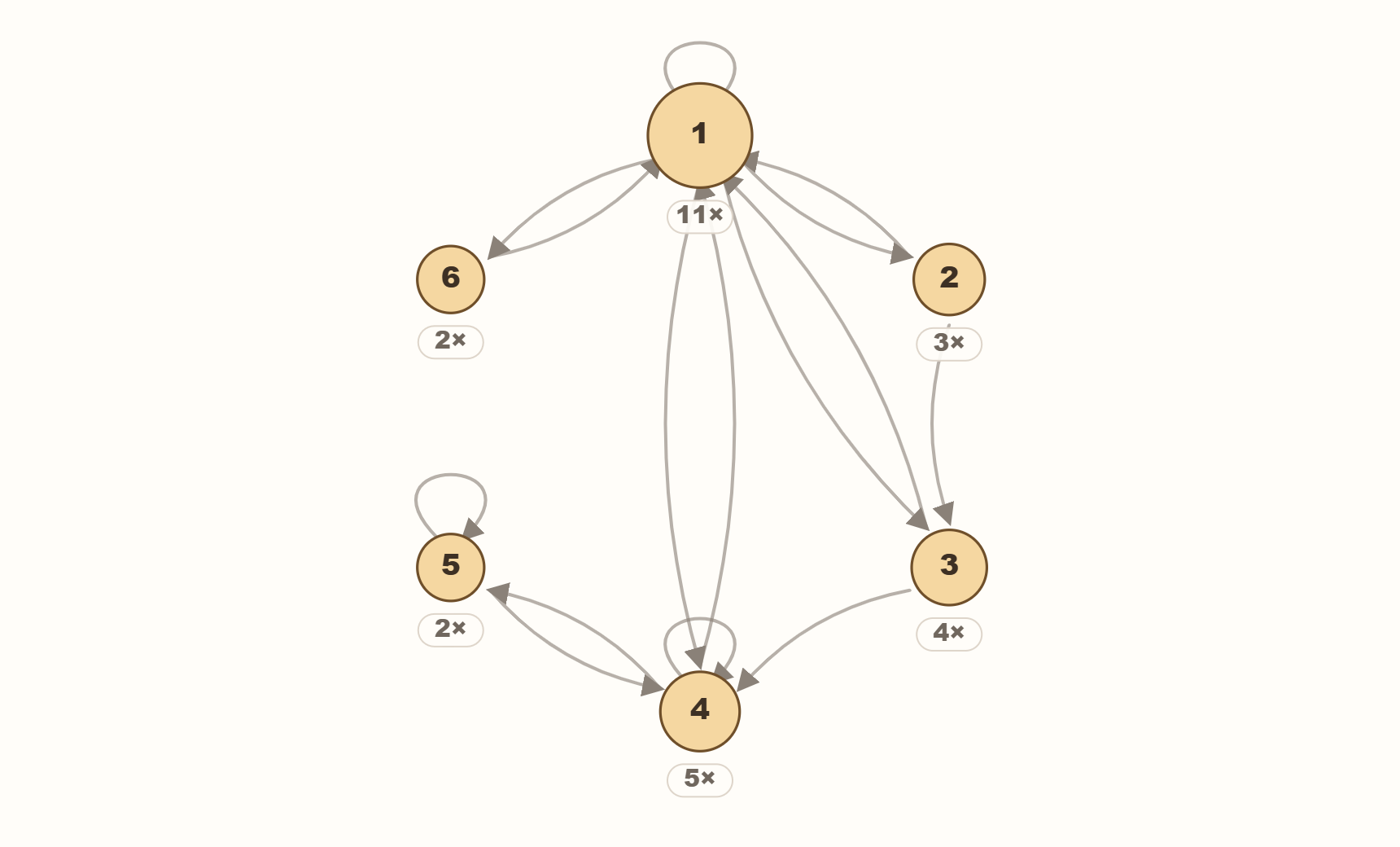
In the study, we found that patients with schizophrenia produced a higher density of noun phrases and more recurrences of previously introduced entities. Crucially, these recurrences tended to occur across larger topological distances, suggesting a widening of the temporal window in which entities are maintained and reactivated in discourse.
From this perspective, referential speech graphs are not merely graphs of discourse cohesion; they are approximations of the evolving architecture through which speakers construct and maintain a shared world of reference. In schizophrenia, alterations in these networks may therefore reflect disruptions in the linguistic foundations of thought itself.
You can use the speech graphs renderer to visualize referential speech graphs. The automatic annotation of entities and noun phrases has not yet been developed, but texts can be annotated manually following the proposed scheme.
En 2023 publicamos un artículo sobre correferencia en Schizophrenia Bulletin, junto a Alicia Figueroa-Barra y Wolfram Hinzen .
Este trabajo se inspiró en un principio en los speech graphs desarrollados por Natalia Mota y colegas, quienes representaban el discurso como una red de palabras conectadas de acuerdo a una sucesión temporal. Nosotros quisimos abordar una pregunta distinta: cómo los hablantes siguen la pista de las distintas entidades de las que hablan a lo largo de un discurso. Nos interesaba esta pregunta porque diversos estudios han sugerido que la referencialidad —es decir, la capacidad de introducir, mantener y recuperar referentes en una conversación o narración— se encuentra alterada en la esquizofrenia.
Encontramos que los pacientes con esquizofrenia producían una mayor densidad de sintagmas nominales y una mayor cantidad de reapariciones de entidades previamente introducidas. Aún más, estas reapariciones tendían a ocurrir a distancias topológicas mayores dentro del grafo, lo que sugiere una ampliación de la ventana temporal en la que los referentes permanecen activos y pueden ser retomados posteriormente.
Desde esta perspectiva, los grafos referenciales del habla no son solamente grafos de cohesión discursiva: son aproximaciones a la arquitectura cambiante mediante la cual los hablantes construyen y sostienen un mundo compartido de referencia. En esquizofrenia, las alteraciones de estas redes podrían reflejar, por lo tanto, disrupciones en los fundamentos lingüísticos del pensamiento mismo.
Puedes utilizar el speech graphs renderer para explorar este tipo de representaciones. Por ahora, la anotación automática de entidades y sintagmas nominales todavía no está implementada. Sin embargo, los textos pueden anotarse manualmente siguiendo el esquema propuesto, lo que permite construir y visualizar los grafos de referencia a partir de cualquier muestra de discurso.
References:
Mota, N. B., Vasconcelos, N. A. P., Lemos, N., Pieretti, A. C., Kinouchi, O., Cecchi, G. A.,
Copelli, M., & Ribeiro, S. (2012). Speech graphs provide a quantitative measure of thought disorder in psychosis.
PLOS ONE, 7(4), e34928.
https://doi.org/10.1371/journal.pone.0034928.
Mota, N. B., Copelli, M., & Ribeiro, S. (2017). Thought disorder measured as random speech structure classifies
negative symptoms and schizophrenia diagnosis 6 months in advance. NPJ Schizophrenia, 3, 18.
https://doi.org/10.1038/s41537-017-0019-3.
Palominos, C., Figueroa-Barra, A., & Hinzen, W. (2023). Coreference delays in psychotic discourse: widening the
temporal window. Schizophrenia Bulletin, 49(Supplement_2), S153–S162.
https://doi.org/10.1093/schbul/sbac102.